
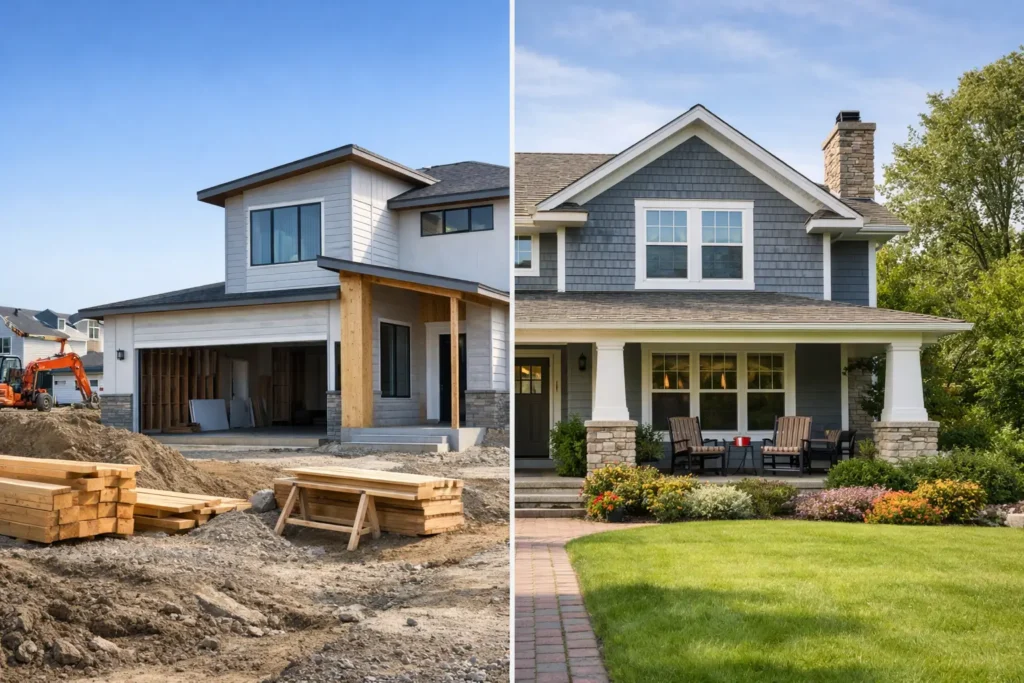
The choice between a new build versus existing home usually gets real fast – right around the moment you realize one house is move-in ready with mature trees, and the other has brand-new everything but may still need blinds, fencing, and a mailbox. Both can be a great fit. The better question is which one fits your budget, timeline, and daily life here in Middle Tennessee.
In areas like Crossville, Cookeville, Sparta, Lake Tansi, and nearby communities, buyers often have solid options on both sides. You may find a freshly built ranch with modern finishes, or an existing home with more yard, more charm, and a lower asking price. Neither is automatically better. What matters is how the full picture lines up with what you actually need.
New build versus existing home: start with your budget
A lot of buyers begin by comparing list prices, but that only tells part of the story. A new build often comes with a higher purchase price than a similar existing home. In return, you may get lower repair costs early on, better energy efficiency, and updated materials that can save money over time.
An existing home may look more affordable upfront, and sometimes it is. But if the roof is near the end of its life, the HVAC is older, or the kitchen needs work, your lower price can quickly turn into a larger total investment. That does not mean existing homes are a bad deal. It just means the smart comparison is not price alone. It is price plus likely expenses over the next few years.
For first-time buyers or anyone trying to stay in a comfortable monthly payment range, this matters a lot. A lower mortgage on an older home can be helpful, but not if every season brings another surprise repair. On the other hand, stretching too far for a new build can leave you house-rich and cash-poor. The sweet spot is finding a home you can afford without feeling squeezed after closing.
What you get with a new build
The biggest draw of a new construction home is simple: fewer immediate headaches. New roof, new systems, new appliances, new wiring, new plumbing. That can bring real peace of mind, especially for buyers who do not want to spend weekends handling repairs.
New builds also tend to reflect what buyers want right now. Open layouts, larger closets, better insulation, more outlets, and practical kitchen design are common selling points. For retirees and downsizers, single-level floor plans can be especially appealing. For families, modern layouts often make everyday living easier.
There can also be some customization, depending on the stage of construction. You might be able to choose flooring, paint, countertops, or exterior details. That can make the home feel more personal from day one.
But a new build is not always as finished as buyers expect. You may still need to budget for landscaping, window treatments, gutters, fencing, or upgraded storage. Some neighborhoods are also still developing, which means construction traffic, fewer mature trees, and a less settled feel for a while.
What you get with an existing home
Existing homes often win on character, lot size, and location. In many established neighborhoods, you will find mature landscaping, larger yards, and homes built in areas that are already close to schools, shopping, medical care, or local lake access. That can be a major advantage if convenience is high on your list.
There is also something to be said for seeing exactly what you are buying. With an existing home, the neighborhood has a track record. You can get a sense of traffic, noise, upkeep, and overall feel right away. You are not trying to picture what the area might become two years from now.
Older homes may also offer features that are harder to find in newer construction at the same price point, like larger porches, detached workshops, extra storage buildings, or simply more square footage for the money.
Of course, with charm can come maintenance. Even a well-cared-for home can have aging systems or dated finishes. Some buyers are happy to make improvements over time. Others want something turnkey. Be honest with yourself here. Watching renovation shows and living through one are not the same experience.
Timing matters more than most buyers expect
If you need to move quickly, an existing home often gives you more certainty. You tour it, inspect it, negotiate, and close. A new build can work just as well if it is already completed or near completion, but if you are building from the ground up, delays can happen. Weather, materials, labor, and permitting can all affect the timeline.
That does not make new construction risky by default. It just means your move date may need some flexibility. If your current lease is ending, your home is already under contract, or you are relocating for work, that timeline deserves close attention.
For buyers who are not in a rush, waiting on a new build may be worth it. For buyers who need a home now, an existing home can remove some uncertainty.
New build versus existing home in Tennessee communities
Local market conditions can shape this decision more than national headlines do. In our part of Tennessee, buyers are often balancing affordability with lifestyle. Some want a quiet neighborhood near town. Others want extra land, a lake-area setting, or a practical one-level home that will still work well years from now.
A new build versus existing home decision can look very different in Crossville than it does in a denser metro area. Here, land availability, builder activity, and neighborhood style all play a role. You may find that a new build offers strong value in one area, while an existing home gives you more lot size and better location in another.
This is where local guidance helps. The right answer is not just about the house. It is also about where that house sits, what that area offers, and how easy it will be to resell one day if your plans change.
Think about upkeep, not just appearance
A home can look beautiful on showing day and still require very different levels of maintenance depending on its age and setup. Newer homes generally need less attention in the early years. That can be ideal for busy families, retirees, or anyone who wants predictable ownership costs.
Existing homes vary more. Some have been meticulously maintained. Others have had cosmetic updates that hide bigger issues. A good inspection matters in either case, but it becomes especially important when you are buying an older property.
Also think beyond repairs. A larger yard, mature trees, older decks, or outbuildings may add value and enjoyment, but they can also add work. For some buyers, that is part of the appeal. For others, low-maintenance living wins every time.
Lifestyle should break the tie
If both options seem financially possible, lifestyle should be the deciding factor. Ask yourself what kind of daily experience you want. Do you want modern finishes, efficiency, and fewer repair worries? A new build may fit best. Do you want an established neighborhood, a larger lot, or a home with more personality? An existing home may be the better match.
It also helps to think a few years ahead. If you plan to age in place, single-level new construction or a well-designed ranch home could make life easier. If you value walkable neighborhoods, mature shade, or a workshop out back, an older property may check more boxes.
There is no prize for choosing the option that looks best on paper if it does not fit your real life.
The smartest buyers compare the whole picture
When buyers slow down and compare total cost, timing, maintenance, location, and lifestyle, the decision usually becomes clearer. That is true whether you are buying your first home, downsizing, relocating, or looking for something affordable that still feels like a good long-term move.
At 931 Dream Homes, we see buyers succeed when they stop asking which type of home is better and start asking which one is better for them. That small shift changes the conversation in a good way.
A home should support your next chapter, not complicate it. If a brand-new build gives you peace of mind, that matters. If an existing home gives you more space, a better setting, or a stronger value, that matters too. The best choice is the one that feels right after you have looked at the numbers and the day-to-day reality – not just the listing photos.